
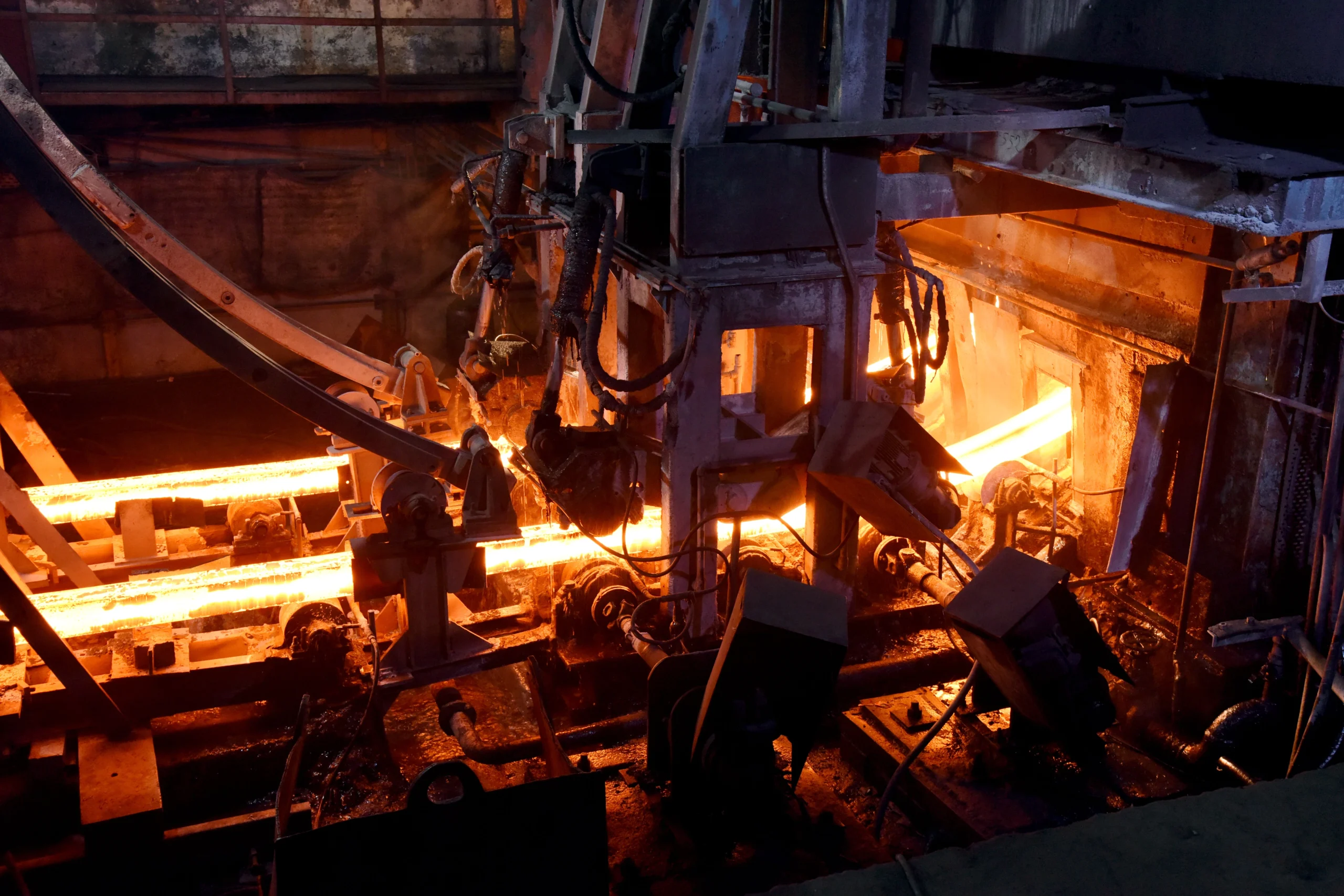
To understand the difference between billet and ingot, it is important to learn about the material supply chain in steel and metallurgical processing. Though, as much as the two are intermediate products of metal between raw materials and finished products, the two differ significantly in respect of production processes, physical characteristics, and intended use. This guide explains these ingot vs billet differences and their impacts on the processes on the industry.
What Are Ingots and Billets? Understanding the Fundamentals
- Steel Ingots are the initial solid state, which molten steel fills once it is poured out of the furnace. An ingot is a large block of metal, typically formed by pouring molten steel into molds that shape it into a basic geometric form as it solidifies. Ingots are used as the main medium of storing and transporting of steel before it is further processed.
- Steel Billets are half-finished products that are formulated either by hot rolling or continuous casting of steel. They are not only at an earlier stage of processing than ingot stage, but also have more polished dimensions and surface quality. Billets are a semi-finished form of raw ingots and finished steel products.
In short, the key point in the ingot vs billet comparison is that ingots are the primary cast form of steel, whereas billets are refined, semi-finished forms suitable for direct processing.
Manufacturing Processes
Ingot Production
The traditional ingot-making process follows these steps:
- Melting and Refining: Steel is melted in electric arc furnaces, basic oxygen furnaces, or induction furnaces. The molten metal undergoes refining to achieve the desired chemical composition and remove impurities.
- Casting into Molds: It is poured into heavy cast iron or steel molds into the liquid steel, which is normally heated between 1,500 and 1,600°C. These molds are tapered in shape in order to be removed once they have solidified.
- Solidification: The steel cools to solidify and solidifies at the outside inwards. Depending on the size of the ingot, this process can be carried out over a few hours where the internal structures are developed which may contain some defects such as pipe shrinkage, segregation and gaseous pores.
- Stripping and Conditioning: Ingots are removed out of the molds once they are cool enough. Surface flaws can be eliminated by scarfing or grinding and then proceeded with.
The sizes of ingots are significantly different, and they may reach several hundred kilograms and even more than 300 tons in special cases. The most common ingot shapes are square, rectangular and round cross-section.
Billet Production
Two major processes are used in the modern manufacture of billet:
Continuous Casting (Modern Approach):
This process has largely replaced traditional ingot casting in contemporary steel mills:
- This operation has to a large extent substituted the ingot casting of modern steel mills:
- Molten steel is continuously poured out of a ladle into a tundish into a water-cooled copper mold.
- The steel shell starts to solidify as soon as it is in touch with the cold walls of the mold.
- The partially solidified one is constantly pulled off and cooled more in sprays of water.
- After the process is complete the strand is cut to the lengths required using automated cutting torches.
- The procedure is continuous and billets are formed without using the intermediate ingot step.
In modern practice, continuous casting dominates the ingot vs billet production chain due to its efficiency and consistency.
Hot Rolling from Ingots (Traditional Approach):
Where there is no continuous casting facility:
- Heating in soaking pits is done to a uniform temperature of about 1,200 °C to gain homogenous heating of ingots.
- The hot ingots are rolled through sequential rolling mills.
- The reduction takes place in several passes, with a reduction in cross-sectional area.
- The content is structured into billets of specific dimensions and enhanced surface quality.
- Finally, dimensions are generally between 100 mm and 150 mm square cross-section.
Physical Characteristics and Dimensions
Ingot Specifications
Ingots exhibit certain characteristic features:
Dimensional Range:
- Weight: 1-300 tons depending on application
- Cross-section: 300mm to over 1,000mm
- Length: 1-6 meters typically
Surface Quality: Ingot Surfaces are fairly coarse in nature, with mold marks and surface anomalies, and could have defects. Further examination of surface conditioning is usually necessary before further processing.
Internal Structure: The casting process creates distinct zones:
- Chill zone: Fine-grained outer layer formed by rapid cooling against the mold
- Columnar zone: Elongated grains growing perpendicular to the mold surface
- Equiaxed zone: Central region with randomly oriented grains
- Pipe shrinkage: This occurs in the center of the top of the cavity owing to the volumetric contraction during solidification.
Geometric Form: Ingots usually have tapered sides to ease the process of removal of the mould and may possess some form of geometrical shape, such as feeding heads, to roll back the process of shrinkage.
Billet Specifications
Billets demonstrate more refined characteristics:
Dimensional Range:
- Cross-section: Square billets are usually 100mm x 100mm -150mm x 150mm.
- Length: 6-12 meters standard, though custom lengths are available
- Weight: 1-3 tons per piece typically
Surface Quality: Billets have relatively smooth surfaces with minimal defects. Continuous cast billets achieve surface quality superior to rolled products from ingots. Surface finish typically meets requirements for direct use in subsequent hot working operations.
Internal Structure: Continuous casting produces finer, more uniform grain structures compared to ingot casting. Reduced segregation and fewer internal defects characterize modern billet production.
Geometric Precision: Billets maintain consistent cross-sectional dimensions along their length with tight tolerances, typically within ±3 mm for cross-sectional dimensions.
Composition and Material Grades Chemical
Ingots as well as billets can be made out of different steel grades:
- Carbon Steel: The low carbon (0.05-0.25% C), medium carbon (0.25-0.60% C), and high carbon (0.60-1.00% C) are used in various applications due to the strength and ductility properties.
- Alloy Steel: Additions of such elements as chromium, nickel, molybdenum and vanadium give the specific properties such as increased strength, ability to withstand corrosion or high-temperature.
- Stainless Steel: Over 10.5% chromium will be used, which is resistant to corrosion. Various applications are made of austenitic, ferritic and martensitic grades.
- Tool Steel: Hardness and wear resistance of cutting tools and dies are attained by a high concentration of alloy.
These dimensional and structural differences highlight a crucial difference between billet and ingot in terms of quality, geometry, and suitability for downstream processing.
Applications and End Uses
Ingot Applications
Ingots are applied to a particular manufacturing requirement:
Heavy Forging: Massive forged components are made using large ingots as stock material. They include:
- Generating power rotors and generator shafts.
- Components of chemical and petrochemical industries pressure vessels.
- Components of marine engines and ship propeller shafts.
- Huge machinery structural parts.
Rerolling Mills: When there are no continuous casting facilities or it is economically undesirable, smaller steel mills purchase ingots to be rolled into a variety of semi-finished products.
Specialty Products: There are still some high-value specialty steels and superalloys which are not made by continuous casting because tonnage requirements do not warrant continuous casting production, or where a particular metallurgical property is favorable to the ingot route.
Investment Casting: There are some precision casting processes which utilize small ingots as charge material to be remelted in a vacuum or controlled atmosphere furnace.
Billet Applications
Billets undergo further processing into numerous finished products:
Long Products Manufacturing:
- Hot rolling of wire rod through wire rod mills.
- Concrete reinforcement (reinforcement bars) construction.
- Flat, round, square, and hexagon merchant bars.
- Structural subsections such as angles, channels and beams.
Seamless Pipe Production: The billets are the main feedstock used to manufacture seamless pipes. The billet is heated and pierced to make hollow shells, which are then lengthened and made to size into seamless pipes to be used in critical applications in oil and gas, generation of power, and in mechanical engineering.
Forging Operations: Operations Forged products are made using billets of medium size, such as:
- Car parts (gears, connecting rods, crankshafts)
- High-integrity aerospace components.
- Industrial machinery parts
- Hand tools and hardware
Bar and Rod Products: The additional rolling results in bars and rod materials that are used to form finished parts in various industries.
Quality Considerations and Defect Management
Ingot Quality Challenges
Traditional ingot casting has a number of quality issues:
- Pipe Shrinkage: The shrinkage of the ingot in the solid state forms a central cavity in the top of the ingot. Such a defect demands a heavy crop to be grown, which decreases harvest.
- Segregation: Elements and impurities are concentrated in areas that freeze last forming a compositional disparity in the ingot. This macrosegregation may have an impact on the final products.
- Porosity and Inclusions: During solidification, gases and slag can be trapped, and this can form internal defects which need to be detected by use of ultrasonic test or any other non-destructive techniques.
- Surface Defects: Mold/metal interaction, thermal stress, and handling may create surface cracks and laps as well as other irregularities, which they must remove prior to process.
Therefore, in the ingot vs billet comparison, billets typically provide superior metallurgical and surface quality.
Scale Considerations
Large-Scale Operations: Continuous casting is used universally in modern integrated steel mills as a way to make use of economies of scale and produce billets to be used in downstream processing.
Small-Scale Producers: A few smaller producers still keep ingot casting to be able to make small amounts of different grades, or may have some specialty use in which continuous casting economics are inapplicable.
Specialty Producers: The manufacturers of high-value alloys and other types of specialty steels can use ingot routes to meet certain metallurgical needs, or when the volume of production is not sufficient to warrant the infrastructure of continuous casting.
Future Trends and Technological Developments
The steel industry keeps developing in the semi-finished production of products:
- Near-Net-Shape Casting: Higher technologies make castings that are nearer to the geometry of the final product and this aspect lowers the further processing needs and the waste of material.
- Quality Control Systems: Real-time Detection through advanced sensors, artificial intelligence, and machine learning: Predicting the quality in the continuous casting processes and control of the process is improved by real-time monitoring.
- Thin Slab Casting: Technology advances allow creating slabs and sections with a thickness that is even lower, which reduces energy use and manufacturing processes.
- Automation Integration: More automation in the material handling, quality inspection, and process control helps in enhancing consistency and lowering the operating costs.
- Specialty Grades: The creation of new steel grades and alloys which are optimized to certain conditions of continuous casting increases the number of materials that can be used in direct production of the billet.
Selection Criteria: Ingots vs Billets
The ingots or the billets should be chosen by the manufacturers, which should take into account:
- Production Volume: Continuous casting is an efficient way of producing billets that is preferred in high-volume production. Ingots can be used to produce in low volumes or specialty.
- Product Requirements: Large cross-sectional forgings possibly used in large products can be in need of ingots. Billets are put to good use in standard long products and pipes.
- Quality Specifications: Billets made through continuous casting may be of benefit to critical applications that may demand maximum internal soundness.
- Equipment: The equipment capabilities and the existing facilities determine choice of the material forms and sourcing decisions.
- Economic Analysis: The life-cycle cost analysis which considers material cost and processing requirements, yield factors, and energy consumption helps in making the right choice.
- Supply Chain Factors: The availability of materials, supplier, and logistics play a role in sourcing activities.
Conclusion
Ingots and billets both have different positions within steel manufacturing value chain. Ingots are the original solid state of steel, which is used in large forgings and where large cross-sections are involved. Billets which are either cast continuously or by means of working ingots provide refined size, better quality and efficiency in the production of long products, seamless pipes and forging.
The shift of the steel industry towards continuous casting is an indication of the better economics, quality, environmental performance of direct billet production. Nevertheless, ingots are still applicable in specialty applications, large forgings and when the volume of production or technical considerations are in their favor.