
ERW Pipe vs Seamless Pipe: A Complete Comparison for Industrial Applications
In the world of steel piping, choosing the right pipe is not just a technical decision. It directly impacts safety, performance, cost efficiency, and the long-term reliability of your entire project. Whether it is a high pressure oil pipeline, a structural framework, or a water distribution system, the type of pipe you select plays a critical role in determining how well your system performs under stress.
Among the most widely used industrial pipes today are ERW pipes and seamless pipes. While they may look similar from the outside, their manufacturing process, mechanical properties, pressure handling capability, and applications are quite different.
If you are comparing Erw Pipe vs seamless pipe for your next project, this detailed guide will help you understand which one suits your specific requirements.
What is an ERW Pipe
ERW stands for Electric Resistance Welded. ERW pipes are manufactured from steel coils or steel strips that are cold formed into a cylindrical shape. The edges are then heated using electric resistance and welded together longitudinally to form a continuous seam.
Key Characteristics of ERW Pipes
- Manufactured from steel coils or strips
- Contains a longitudinal weld seam
- Good dimensional accuracy
- Smooth surface finish
- Cost effective production
- Suitable for low to medium pressure applications
ERW steel pipes are widely used in structural applications, water pipelines, gas distribution, fencing, scaffolding, and mechanical engineering projects.
What is a Seamless Pipe
Seamless pipes are produced without any welding. The manufacturing process begins with a solid round steel billet that is heated and pierced to create a hollow tube. This hollow shell is then elongated and rolled to achieve the required diameter and wall thickness.
Key Characteristics of Seamless Pipes
- Manufactured from solid steel billets
- No weld seam
- Uniform grain structure
- High pressure resistance
- Suitable for high temperature services
- Generally higher cost compared to ERW
Seamless steel pipes are commonly used in oil and gas pipelines, petrochemical plants, boilers, heat exchangers, power plants, and hydraulic systems.
ERW Pipe vs Seamless Pipe: A Comprehensive Technical Comparison
When evaluating ERW pipe vs seamless pipe, the difference goes far beyond the presence or absence of a weld seam. The two pipe types differ in manufacturing technology, metallurgical structure, pressure rating, dimensional tolerance, mechanical strength, inspection standards, and cost efficiency.
For engineers, procurement managers, and project consultants, understanding these technical differences is essential for selecting the right pipe for structural applications, fluid transportation systems, or high pressure industrial pipelines.
Here is a quick comparison of ERW pipe vs seamless pipe:
| Parameter | ERW Pipe | Seamless Pipe |
| Manufacturing Method | Cold formed from steel coil and high frequency welded | Hot pierced from solid billet and rolled |
| Weld Seam | Present longitudinal seam | No weld seam |
| Structural Integrity | Strong with welded joint | Fully homogeneous structure |
| Pressure Rating | Low to medium pressure | High pressure capable |
| Mechanical Properties | Excellent but weld zone differs slightly | Uniform tensile and yield strength |
| Dimensional Accuracy | High dimensional precision | Slight variation possible |
| Wall Thickness Tolerance | High consistency | May vary due to hot rolling |
Manufacturing Process and Production Technology
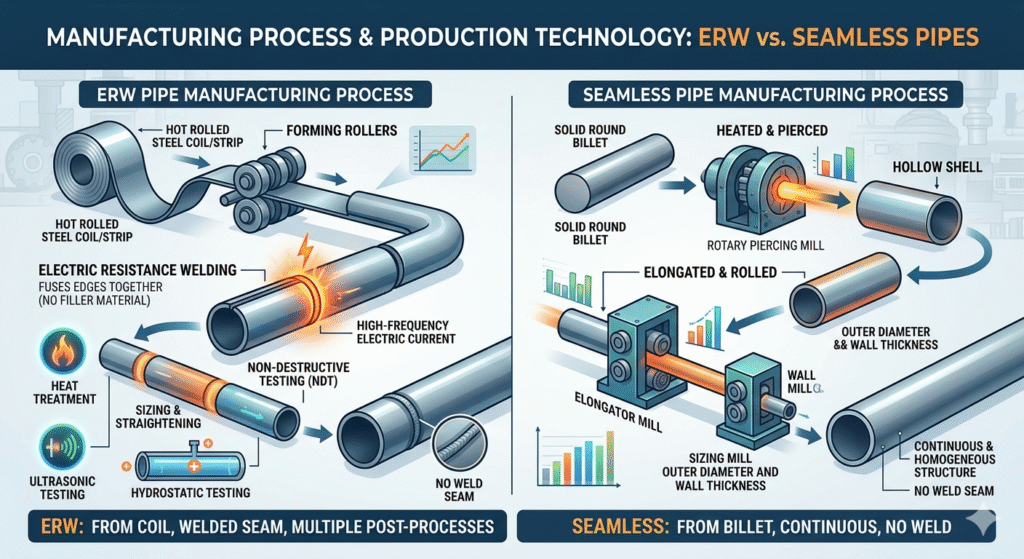
ERW pipes are produced from hot rolled steel coils or strips. The strip is passed through a series of forming rollers that gradually shape it into a cylindrical form. The edges are then joined using high frequency electric resistance welding. The heat generated by electrical current fuses the edges together without the use of filler material. After welding, the pipe undergoes heat treatment, sizing, straightening, and non destructive testing such as ultrasonic testing or hydrostatic testing.
Seamless pipes, on the other hand, are manufactured from a solid round billet. The billet is heated to high temperatures and pierced through the center using a rotary piercing mill to form a hollow shell. This shell is then elongated and rolled to achieve the required outer diameter and wall thickness. Since no welding is involved, the pipe structure remains continuous and homogeneous.
Weld Seam and Structural Integrity
In ERW pipes, a longitudinal weld seam runs along the length of the pipe. With modern high frequency welding and proper heat treatment, the weld zone can achieve strength comparable to the base metal. However, it remains a metallurgical transition area.
In seamless pipes, there is no weld seam. The absence of a welded joint eliminates any potential discontinuity in the metal structure. This provides uniform grain flow and consistent structural integrity throughout the pipe body.
Pressure Rating and Load Bearing Capacity
Seamless pipes generally offer higher pressure ratings due to their uniform structure and absence of a weld joint. They are capable of handling higher internal pressure, extreme temperatures, and dynamic loading conditions. This makes them suitable for steam lines, high pressure oil and gas pipelines, hydraulic systems, and refinery operations.
ERW pipes perform reliably in low to medium pressure applications. With advancements in welding technology and strict quality control under standards such as ASTM and API specifications, ERW pipes today are significantly stronger than older generations. However, for extremely high pressure or critical temperature services, seamless pipes are typically preferred.
Mechanical Properties and Metallurgical Structure
Seamless pipes exhibit uniform mechanical properties because they are formed from a single billet without any joint. The grain structure flows continuously along the pipe, which improves resistance to cyclic loading and high stress conditions.
ERW pipes also provide excellent tensile and yield strength, especially when manufactured using high quality steel coils. However, the weld zone undergoes localized heating and cooling, which can slightly alter metallurgical properties in that area. Modern post weld heat treatment minimizes these differences, but under extreme stress, seamless pipes generally offer greater reliability.
Cost Efficiency and Production Economics
ERW pipes are generally more economical because they use steel coils efficiently and involve lower energy consumption during manufacturing. The production process is faster and more material efficient, making ERW pipes cost effective for large scale infrastructure and construction projects.
Seamless pipes require billet heating, piercing, and multiple rolling stages. The process consumes more energy and raw material, which increases production cost. As a result, seamless pipes are typically priced higher than ERW pipes of comparable size and grade.
Surface Finish and Fabrication Suitability
ERW pipes usually have a smoother surface finish due to controlled forming from steel strips. This makes them suitable for coating, galvanizing, painting, and structural fabrication.
Seamless pipes may require additional surface finishing depending on the application. However, for high temperature and high pressure systems, surface aesthetics are usually secondary to structural performance.
Inspection, Testing, and Quality Standards
ERW pipes are usually subjected to non destructive testing such as ultrasonic testing of the weld seam, eddy current testing, and hydrostatic pressure testing to ensure weld integrity.
Seamless pipes are inspected for internal and external defects using ultrasonic testing and visual inspection. Since there is no weld seam, testing primarily ensures uniform wall thickness and structural soundness.
Compliance with standards such as ASTM, API, and IS specifications ensures both pipe types meet required performance criteria.
ERW Pipe vs Seamless Pipe: Which One Should You Select?
Choosing between ERW Pipe vs seamless Pipe ultimately depends on your project requirements, operating conditions, and budget.
Choose ERW Pipe When
- The application involves low to medium pressure such as water lines, gas distribution, or structural use
- Cost efficiency is a key factor in large scale infrastructure projects
- Dimensional accuracy and uniform wall thickness are important
- The pipe is used for construction, fabrication, or general engineering purposes
ERW pipes offer reliable strength, good surface finish, and economical pricing, making them ideal for non critical pressure systems.
Choose Seamless Pipe When
- The system operates under high pressure or high temperature
- The application involves oil and gas, boilers, steam lines, or petrochemical plants
- Structural uniformity and maximum reliability are required
- Project specifications demand higher pressure ratings
Seamless pipes are preferred for critical applications where safety, durability, and pressure resistance are top priorities.
In the ERW Pipe vs seamless Pipe comparison, neither is universally better. The right choice depends on matching the pipe type to the performance demands of your project.
Why Choose RPMultimetals for Your ERW Pipe Requirements
Selecting the right ERW pipe manufacturer is just as critical as choosing the right pipe type.
RPMultimetals combines strong industry experience with advanced manufacturing practices to deliver high quality ERW pipes that meet precise specifications. Every pipe is produced under strict quality control, ensuring strength, dimensional accuracy, and reliable performance across applications.
Whether the requirement is cost effective ERW pipes for infrastructure, construction, gas distribution, or general engineering projects, RPMultimetals focuses on consistency, durability, and timely supply.
With a commitment to quality and customer satisfaction, RPMultimetals stands as a dependable partner for all your ERW steel pipe needs.