
The short Answer
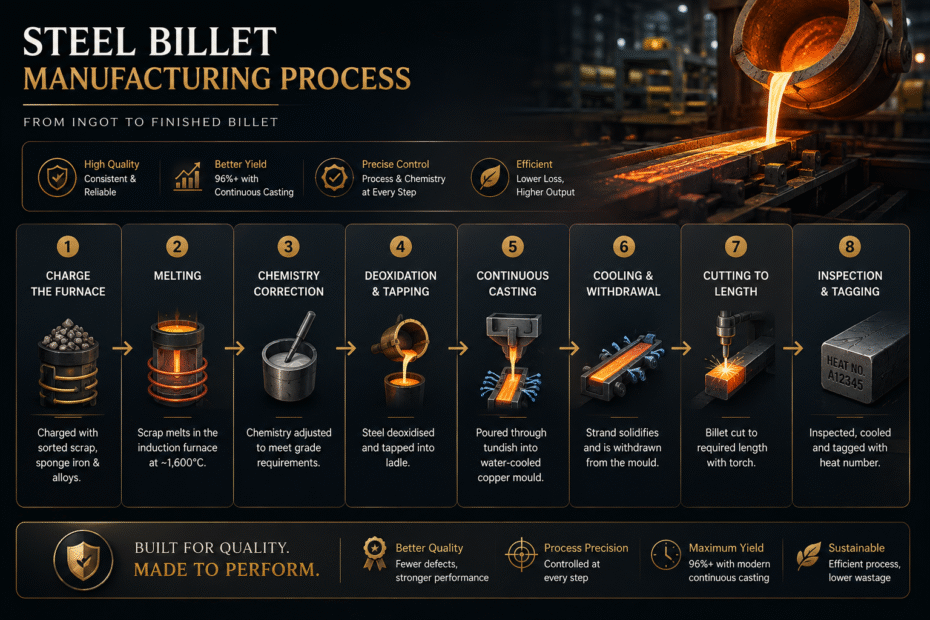
The steel billet manufacturing process runs in eight stages: sort and charge the scrap, melt it in an induction furnace at roughly 1,600°C, correct the bath chemistry, deoxidise and tap into a ladle, pour through a tundish into a water-cooled copper mould, cool and withdraw the solidifying strand, HYDRAULIC CUT it to length, then cool, inspect and tag each billet against its heat number.
That’s the modern route. The older one pour the melt into cast iron moulds, wait for ingots to freeze, reheat them, and roll them down to billet section still exists in India for forging grades and some special steels, and it’s worth understanding because it explains why the industry moved on.
Ingot and billet are not the same thing (and the confusion costs money)
An ingot is a big, tapered casting, usually 500 kg to several tonnes, poured into a mould and left to solidify from the outside in. A billet is a small square section, typically 75mm to 150mm, that goes straight into a rolling mill.
One is a storage form. The other is a feedstock.
The distinction matters commercially because purchase enquiries still arrive asking for “ingots” when what the buyer’s rolling mill actually needs is billets, or the reverse. If you’re not sure which side of that line your requirement sits on, we’ve written a longer breakdown of the difference between steel ingots and billets, and a plain-language explainer on what a steel billet is and where it’s used.
Here’s the part that decided the industry’s direction. When molten steel freezes inside a closed ingot mould, the last liquid to solidify sits at the top centre, and as it contracts it leaves a shrinkage cavity called pipe. You cannot roll that out. You crop it off. Between top crop, bottom crop and scale loss during reheating, ingot-route yield lands somewhere around 82–88%. Continuous casting, running properly, gives you 96% and up.
On 200 tonnes a day, that gap is not a rounding error.
What goes into the furnace before anything melts
Before any of the process steps, four inputs have to be right:
- Steel melting scrap, sorted by grade and free of sealed containers, oil drums, and non-ferrous contamination. Copper is the one that hurts most; there is no practical way to remove it from the bath once it’s in.
- Sponge iron (DRI), used to dilute residuals and pull carbon, sulphur and phosphorus down when a bath sample comes back high.
- Pig iron or foundry-grade CI, added when carbon runs low.
- Ferroalloys: ferro-manganese, ferro-silicon, and aluminium for final deoxidation.
Induction melting has a hard constraint that arc furnace operators don’t face in the same way: there’s no oxidising slag practice worth the name, so you cannot dephosphorise the bath. Phosphorus that enters with the charge leaves with the billet. That single fact governs how a good induction shop buys scrap. You control the input because you cannot fix the output.
At our steel division in Mandi Gobindgarh we run three 15-MT induction furnaces, and scrap segregation on the BIRIM SHEARING and handling line happens before a single basket goes near the coil. Sorting is cheaper than reprocessing.
Step 1: Charging the furnace
The first charge goes in cold, with heavy melting scrap at the bottom of the crucible where the magnetic field couples most strongly, and lighter material on top. Bridging is the failure to avoid: light scrap fuses into an arch above a pool of liquid steel, the pool superheats underneath, and the refractory takes the punishment.
Charge in stages as the bath level drops. Never dump a full basket into a nearly full furnace.
What goes wrong: wet or oil-contaminated scrap. Water trapped under a charge that hits molten steel flashes to steam instantly. Every induction shop has a story about this and none of them are funny.
Step 2: Melting
Induction current does the work. The coil sets up a magnetic field, the field induces eddy currents in the charge, and resistance to those currents generates the heat. Stirring comes free with the physics, which is one reason induction billets tend to be chemically uniform through the section.
A 15-tonne furnace typically takes 90-110 minutes for a full cold heat, faster on subsequent heats with a hot lining. Power consumption sits around 600 kWh per tonne for furnaces in the 15–17 tonne range, and that figure barely improves with larger sizes, so energy is roughly a fixed cost per tonne of billet you sell.
Step 3: Correcting the chemistry
Once the bath is fully liquid, take a sample. Spectrometer reading, then decide.
Carbon high? Add DRI. Carbon low? Add pig iron or a carburiser. Manganese below the grade window? Ferro-manganese. Sulphur creeping up? DRI dilution again, though the honest answer is that you should have caught it at the scrap yard.
This is where grade selection under IS 14650 and the other Indian billet standards becomes an operating instruction rather than a paperwork exercise. The standard defines the chemistry window; the melt shop hits it or the heat gets downgraded. Residual limits on phosphorus and sulphur are tight enough that they need to be read off the grade table for the exact grade you’re producing, not assumed from memory.
Step 4: Deoxidation and tapping
Liquid steel dissolves oxygen. If you let it solidify that way, the oxygen comes out of solution as CO gas during freezing and you get blowholes and pinholes running through the billet.
So you kill the steel BY PURGING WITH NEUTRAL GASES LIKE ARGON AND NITROGEN . Ferro-silicon first, aluminium last, added in the furnace or into the ladle stream. Aluminium is the strong finisher and also the one people over-add, which produces alumina clusters that block the casting nozzle two heats later.
Tapping happens at roughly 1,600–1,650°C for common carbon grades, which is deliberately above the liquidus temperature of the steel, which sits around 1,500–1,520°C for mild steel. The gap is the thermal budget for everything that follows: transfer, ladle heat loss, tundish residence time.
Tap too cold and the caster freezes off. Tap too hot and you burn refractory, waste power, and get coarse solidification structure in the billet.
Step 5: Ladle to tundish
The tundish is a refractory-lined reservoir sitting above the mould. It has three jobs: it buffers the flow so the ladle can be changed without stopping the cast, it distributes steel evenly to multiple strands, and it gives inclusions a few minutes of quiet residence time to float out into the slag layer.
Superheat control lives here. You want the steel entering the mould only modestly above its liquidus. The benefit of low superheat on internal soundness and equiaxed grain fraction shows up strongly once you get inside about 30°C. Push it lower and you risk nozzle freeze-off. Let it run high and centreline segregation gets worse.
Rice husk covers the tundish surface to stop reoxidation from the air.
Step 6: The mould, where the billet actually forms
Steel enters a water-cooled copper tube. Contact with the copper wall freezes a shell in seconds, and by the time the strand exits the bottom of the mould that shell only needs to be around 3mm thick for most grades thin enough to sound alarming, strong enough to contain a liquid core if everything else is right.
Two things keep it from sticking and tearing: MAIN IS CASTING POWDER WHICH IS PORED INSIDE MOULD TUBE DIRECTLY WITH LIQUID METAL WHICH HELPS IT TO FLOW EASILY AND NOT STICK TO OR DAMAGE THE MOULD TUBES
Oscillation. The mould moves up and down continuously so that during part of each cycle it travels downward faster than the strand. That period, negative strip, mechanically breaks any incipient weld between the shell and the copper. The oscillation marks you can see as faint transverse ridges on a cast billet are the signature of this cycle.
Taper. The mould tube is not a straight tube. It narrows toward the exit to follow the shrinking shell as it contracts away from the wall. Get the taper wrong and you lose heat transfer at the corners, which is where rhomboidity and corner cracks come from.
Billet casting speed for 100–130mm sections generally runs in the region of 2–3.5 metres per minute, matched to the section size, the grade, and how much cooling capacity the machine has downstream.
Step 7: Secondary cooling, withdrawal and cutting
Below the mould, water sprays hit the strand directly. This is secondary cooling, and it has to be graded. Too aggressive and the surface goes into tension against a still-hot core and cracks; too gentle and the liquid core survives past the withdrawal rolls and the strand bulges.
Steel has two brittleness zones the cooling profile is designed to walk around. One sits within 30–70°C of the solidus. The other spans roughly 500–900°C. Cracks that appear on a cast billet’s surface almost always trace back to the strand spending time bending or straightening while inside one of them.
The withdrawal and straightening unit pulls the strand out and flattens the curve. THEN A HYDRAULIC SHEARING MACHINE Then a torch cutting machine, travelling at strand speed so the cut stays square, sections it to length. Standard cut lengths in India are 6 metres though we cut our 75mm to 150mm square billets to customer specification, because a rolling mill’s reheat furnace door decides the length far more than any standard does.
Step 8: Cooling bed, inspection and traceability
Cut billets transfer to a cooling bed. Surface inspection follows once they’re cool enough to handle: scarfing or grinding for surface defects, dimensional check on section size, diagonal measurement for rhomboidity, and a straightness check.
Then the paperwork that actually matters. Ladle analysis for the heat, mechanical test results, heat number stamped or tagged on the billet itself. Under the BIS quality control regime for billets, that traceability chain is the difference between saleable material and material you argue about.
A billet without a heat number is a mystery. Nobody’s rolling mill wants a mystery.
Where do ingots still fit?
Forging. Large-section forgings, open-die work, and some tool and alloy steels need a starting size no continuous caster in this size class produces, and a solidification structure that a bottom-poured ingot delivers better than a small strand.
The ingot-to-billet route adds two operations to everything above:
- Reheat. The ingot goes into a soaking pit and comes up to roughly 1,200–1,250°C, held long enough for the centre to reach the same temperature as the surface. Rush this and the core cracks when the rolls hit it.
- Break down. A blooming or cogging mill takes the ingot through successive passes, first to bloom section, then down to billet. Crops come off both ends.
More handling, more scale, more fuel, lower yield. It survives because for certain products there’s no substitute.
What happens to the billet next
A finished billet is an input, not an end product. Most of ours goes one of two directions: into rolling mills that turn it into rebar, rounds, and merchant bar, or through our own hot rolling into HR coil, which is then slit and formed into ERW pipes in the 31–88mm OD range.
That vertical route is also a quality feedback loop. When you roll and weld your own billet, a chemistry problem in the melt shop shows up as a weld defect in your own pipe mill three days later, not as a customer complaint six weeks later. It concentrates the mind.
Defects and what actually causes them
| Defect | What you see | Usual cause |
| Rhomboidity | Off-square section, unequal diagonals | Uneven mould cooling, wrong taper, misaligned mould |
| Corner cracks | Longitudinal cracks at the corners | Poor corner heat transfer, harsh secondary cooling |
| Pinholes / blowholes | Subsurface gas porosity | Incomplete deoxidation, wet additions, moisture in the tundish |
| Centre segregation | Enriched carbon and alloy at the core | High superheat, high casting speed |
| Bulging | Swollen faces between rolls | Insufficient secondary cooling, liquid core too far down |
| Oscillation mark tearing | Deep, irregular transverse marks | Bad negative strip ratio, wrong casting powder |
Nearly all of these come down to process control. That’s the useful thing to know, because a machine that produced sound billets last month and rhomboid billets this month has a setting, a water flow, or an alignment out. The machine is fine. Something drifted.
Common questions
What is the difference between an ingot and a billet?
An ingot is a large casting, usually 500 kg to several tonnes, made by pouring molten steel into a mould and letting it solidify in place. A billet is a smaller semi-finished section, commonly 75–150mm square, produced by continuous casting or by rolling an ingot down. Ingots feed forging and heavy breakdown mills; billets feed rolling mills directly.
At what temperature is a steel billet cast?
Steel is generally tapped at 1,600–1,650°C and enters the mould at a modest superheat above its liquidus, which for common mild steel grades sits near 1,500–1,520°C. Keeping tundish superheat low improves internal soundness, but too low and the casting nozzle freezes.
How long does it take to produce a billet?
A 15-tonne induction heat takes about 90-110 minutes to melt and refine. Casting that heat through a multi-strand billet caster runs roughly 30–45 minutes. So from cold charge to cut billet on the cooling bed, count on two to three hours for a heat, with heats overlapping in a running shop.
Can induction furnaces remove phosphorus from steel?
Not meaningfully. Induction melting has no effective oxidising slag practice, so phosphorus in the charge ends up in the billet. This is why scrap segregation and DRI dilution matter so much in induction-based billet plants, and why an induction shop’s incoming material discipline predicts its product quality better than its equipment list does.
What determines the billet size I should order?
The finished section you’re rolling and your mill’s reduction ratio. Wire rod and small rebar generally take 75–100mm billets, general rebar around 100–125mm, and heavy rebar or larger structurals 130–150mm. Reheat furnace dimensions decide length.
Getting your specification right
The manufacturing process is only half the transaction. The other half is telling your supplier what you actually need: section, length, grade, chemistry limits, tolerance on rhomboidity, and what test certificates you want with the load.
Vague enquiries get vague material. If you’re putting together a specification for your rolling mill, start with the billet sizes and grades guide, then talk to us about the grades and sections we run.
R.P. Multimetals has been melting and casting steel since 1997, and rolling and forming it for nearly as long. If you want to discuss a requirement, standard section or special grade, get in touch with the steel division.