
Circular Economy Steel India
Circular Economy Hub: Scrap to Steel, Dust to Zinc
One plant in Mandi Gobindgarh, Punjab. Two recycling loops. Scrap becomes steel, and the dust from melting it becomes zinc.
Mandi Gobindgarh is known as Punjab’s steel town, and for years it had a dust problem. Induction furnaces here capture a hazardous dust in their pollution control equipment. In 2017, Hindustan Times reported that each furnace unit paid ₹5,000 a tonne to have it buried in cemented blocks at a site in Zirakpur.
We’ve melted steel in this town since 2000. Scrap is our raw material, and every stage from melting to finished pipe happens on one site. In 2023 we added the last piece: a Zinc Division that turns induction furnace waste into high-purity zinc instead of sending it away to be buried.
This page brings that whole story together: how the loops work, what they’ve recycled so far, what we can and can’t claim, and where to read more.
What does a circular economy mean for steel and zinc?
A circular economy in steel means making new steel from scrap instead of mined iron ore, and recovering the metals in steelmaking waste instead of landfilling them. For a scrap-based plant, that covers two loops: scrap back into steel, and zinc from galvanized scrap back into zinc.
Steel suits this better than almost any material. It can be melted and recast again and again, and India’s Steel Scrap Recycling Policy (2019) treats scrap as the industry’s secondary raw material, with promoting a circular economy as its first aim.
The payoff per tonne is large. According to worldsteel figures reported by EUROMETAL, every tonne of scrap used to make steel avoids:
| Avoided per tonne of scrap | Amount |
| CO2 emissions | 1.5 tonnes |
| Iron ore | 1.4 tonnes |
| Coal | 740 kg |
| Limestone | 120 kg |
Zinc is the less obvious half. Roofing sheets, pipes and car panels are coated in zinc, and when that scrap melts, the zinc ends up in the furnace dust. Dust from melting galvanized scrap can hold 15% to 40% zinc. Bury it and you bury a metal India has to produce or import. Recover it and the loop closes.
Our recycling counter
CO2 avoided is estimated by multiplying the scrap we melted by worldsteel’s global average of 1.5 tonnes of CO2 avoided per tonne of scrap. It compares our route with making the same steel from iron ore and is not a measured footprint of our plant. Figures are updated once a year.
Why circularity matters for Indian steel
India already runs on a lot of recycled metal, and most people never see it. The kabadiwala who buys old pipes and appliances door to door is the first link in a chain that ends in a melt shop like ours. A paper by CEEW and India’s G20 Secretariat makes the same point: circular habits are old here. What’s new is the scale and the pressure to measure them.
Here’s how India made its crude steel in 2023–24, according to Ministry of Steel data reported by S&P Global:
| Avoided per tonne of scrap | Amount |
| CO2 emissions | 1.5 tonnes |
| Iron ore | 1.4 tonnes |
| Coal | 740 kg |
| Limestone | 120 kg |
So more than half of India’s crude steel already comes out of electric furnaces, the kind of furnace that can run on scrap. Whether that steel is actually circular depends on what goes into the furnace. Much of the sector still blends in coal-based sponge iron. A scrap-led charge, like ours, is where the circular benefit is largest.
How large? CEEW’s paper, Unlocking India’s Circular Waste Economy Potential, estimates that each tonne of scrap recycled cuts greenhouse gas emissions by 58%, water use by 40% and mining waste by 97%. Across the whole economy, it puts the prize for a circular strategy at INR 40 lakh crore a year by 2050, with emissions about 44% lower.
Policy points the same way. India’s Steel Scrap Recycling Policy (2019) set out to formalise scrap collection and dismantling so high-grade scrap can be recycled into high-grade steel. The Ministry of Steel’s green steel taxonomy, launched in December 2024, now rewards plants that can prove low emissions. And in April 2026, Union Steel Minister H. D. Kumaraswamy told an industry workshop that the sector’s future has to be built on circular economy principles and decarbonisation.
For a secondary producer, none of this is abstract. It decides who buyers trust, which plants get certified, and which ones get left behind.
The steel loop and the zinc loop
Both loops run inside one plant, and the second one starts where the first one leaves its waste.
The steel loop: scrap to finished pipe
1. Sort
Scrap arrives at a BIRIM MAKINA scrap sorting and crushing machine. Sorting at the gate is where unwanted elements get caught, before they can reach the melt.
2. Melt
Sorted scrap goes into our three 15-MT furnaces, and every heat is chemically analysed before it's cleared.
3. Cast
Since 2013, continuous casting has turned the melt into billets , 75 mm to 150 mm square.
4. Roll
Our rolling mill turns billets into HR coil 1.6 mm to 4 mm thick. We were among the first in Punjab to hot-roll the strip before coiling it.
5. Form
The same coil feeds our pipe plant, which makes ERW pipes from 31 to 88 OD.
Because one company owns every stage, the Mill Test Certificate at the end describes metal we controlled from the melt onward. Our products comply with IS 2830, IH 10748, IS 4923, IS 3601, IS 1239 and IS 1161.
The zinc loop: furnace dust to zinc
1. Capture
Melting galvanized scrap releases zinc, which is caught as dust by the furnace's pollution control system.
2. Recover
Our Zinc Division, running since 2023, takes this hazardous induction furnace waste and recovers high-purity zinc from it, with output capacity of 5 MT a day.
3. Test
Our own lab runs composition and purity checks on every batch. If a batch doesn't meet the standard, it doesn't leave the lab.
4. Sell
The zinc leaves as zinc sheets at 99.5%+ purity, which can be processed further into zinc ingots at 99% purity and above.
5. Return
Galvanizers use the ingots to coat new steel. Decades later that steel comes back as scrap, and its zinc reaches our dust again.
The ingots also go into brass, bronze and die-casting alloys, chemicals and pharmaceuticals, rubber and plastics, and batteries. The sheets go into roofing, cladding, gutters and fabrication. The top row is the steel loop; the bottom row is the zinc loop that starts from its dust, and both return to the yard as scrap.
The furnace dust problem, up close
Why does melting scrap make dust at all? Zinc boils at a much lower temperature than steel melts. So when galvanized scrap goes into the furnace, its zinc coating turns to vapour, leaves with the furnace gases and is caught as fine dust in the pollution control equipment. A 2022 review in the journal Materials explains that this zinc is also why the dust usually can’t simply be fed back into steelmaking.
The volumes are not small. A European research consortium led by Montanuniversität Leoben reported in February 2026 that electric arc furnaces in the EU alone generate more than 1.5 million tonnes of this dust a year, and more than 10 million tonnes worldwide. It is classified as hazardous waste. Where it is recycled, the usual method is the Waelz process, which is carbon-intensive and leaves slag that still goes to landfill.
| Mandi Gobindgarh | Figure |
|---|---|
| Induction furnaces in the town | 102, of which 60 operational |
| Operational rolling mills | 245 |
| Hazardous waste per tonne of iron produced | 5 kg |
| Cost to dispose of furnace dust | ₹5,000 per tonne, buried in cemented blocks at Zirakpur |
| Pilot zinc recovery capacity | 10 tonnes of dust a day, yielding 4 tonnes of zinc |
The same report noted that the Central Pollution Control Board had asked other state boards to set up similar units. The direction was clear: furnace dust should be treated as a source of metal, not a disposal bill.
That’s the gap our Zinc Division was built to close in 2023. It takes hazardous induction furnace waste, recovers the zinc, and sells it as sheets and ingots instead of paying to bury it.
Why recycled zinc matters for India
India uses more zinc than it makes, and the gap is growing. Recovering zinc from furnace dust adds domestic supply without opening a mine. The numbers from BigMint’s April 2026 analysis:
| India's zinc market | 2022 | 2025 |
|---|---|---|
| Consumption | 0.7 million t | about 1 million t |
| Imports | 0.26 million t | 0.36 million t |
| Domestic production | 0.81 to 0.85 million t across 2022–25 | 0.85 million t |
Galvanising took nearly 72% of India’s zinc in 2025. Infrastructure-grade galvanized steel uses 100 to 120 kg of zinc per tonne, so every new transmission tower, solar mounting structure and pipeline pulls more zinc into the market. BigMint projects demand of around 2 million tonnes by FY 2030, against domestic output of about 1.2 million tonnes.
That’s where the circle gets interesting. The galvanized steel being installed today is tomorrow’s scrap. When it comes back to a melt shop, its zinc ends up in the dust, and a recovery plant can return it to the galvanizers. The more India galvanizes, the more zinc there is to recover later.
Milestones, 1997 to 2023
We built the loop one stage at a time, and each new stage took the previous stage’s output as its input.
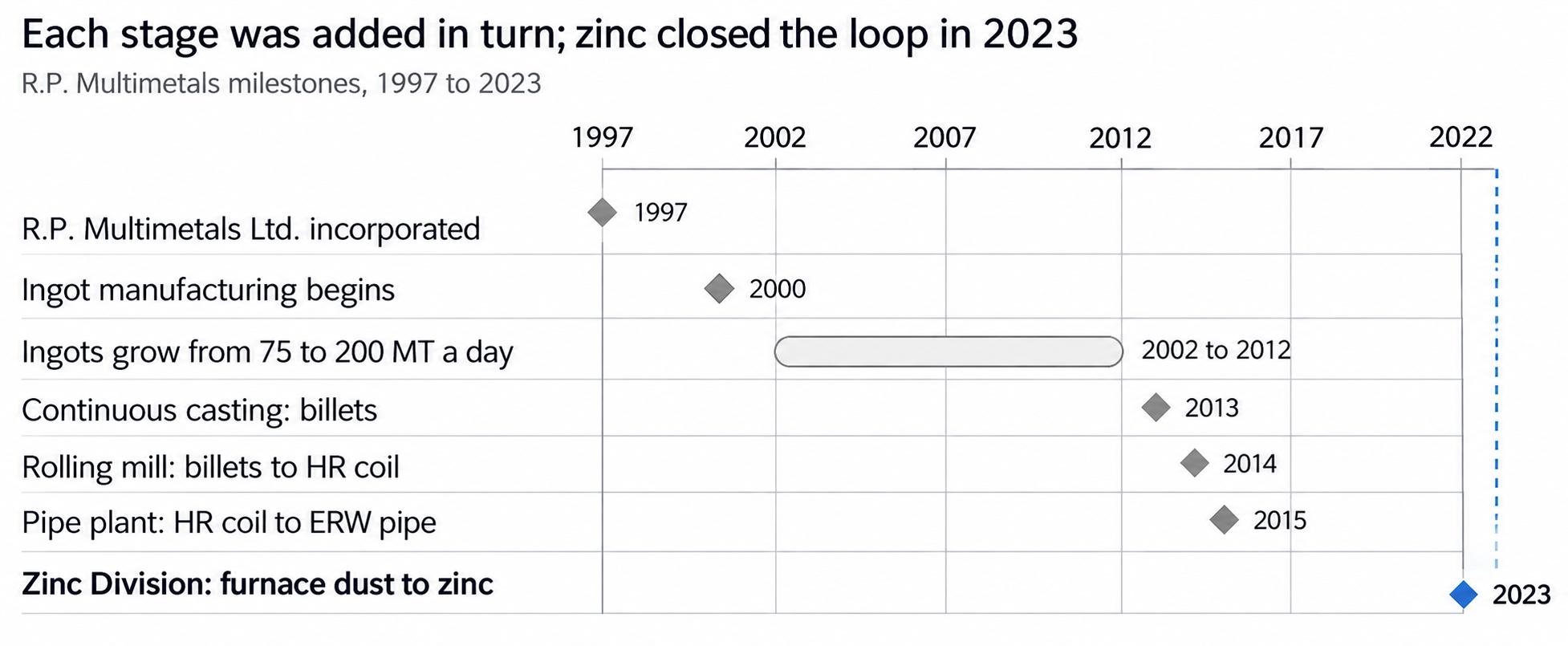
The zinc plant in 2023 was the first stage to take a waste stream rather than a product as its input.
What we claim, and what we don't
Circular economy pages are full of big promises, so here’s exactly where we stand.
| We can show | We don't claim (yet) |
|---|---|
| Scrap is our raw material from sorting to finished product | That our steel is certified green steel |
| Hazardous induction furnace waste is recycled into zinc not disposed of | A measured carbon footprint per tonne for our plant |
| Zinc output capacity of 5 MT a day at 99%+ purity | A star rating under India's green steel taxonomy |
| Products tested to six Indian Standards | Zero waste across the whole plant |
Why the right-hand column? Under the Ministry of Steel’s Taxonomy of Green Steel, “green steel” means a plant with verified emissions below 2.2 tonnes of CO2e per tonne of finished steel, certified by NISST. Scrap gives us a strong start, but the label depends on measured numbers we haven’t published. Until we have them, we’ll describe what we do and leave the labels to the certifiers.
Five myths about recycled steel and zinc
These come up again and again in steel and zinc buying. Here are the straight answers.
Myth 1: “Steel made from scrap is weaker.” For standard structural and general engineering grades, it isn’t. Indian Standards set mechanical properties and composition limits; they don’t specify which furnace the steel came from. Meet the numbers and you’ve met the standard. Primary steel does keep an edge in a few niches, such as cold heading, deep drawing and ultra-low-impurity parts, and we say so in our scrap vs primary steel guide.
Myth 2: “Steel wears out each time it’s recycled.” The iron doesn’t change. What can change is what comes in with the scrap: stray copper and tin that don’t burn off in the melt. That’s why our scrap is sorted at the gate and every heat is chemically analysed before it’s cleared.
Myth 3: “Recycled means certified green.” Not on its own. India’s green steel label depends on a plant’s verified emission intensity. Recycling gives a strong head start, and certification is a separate step.
Myth 4: “Furnace dust is just waste.” Dust from melting galvanized scrap can hold 15% to 40% zinc. Treated as waste, it costs money to bury. Treated as ore, it becomes zinc sheets and ingots.
Myth 5: “Zinc from waste can’t be high purity.” Our zinc sheets are 99.5%+ pure and our ingots 99% and above, and no batch leaves our lab without passing composition and purity checks.
What this means for buyers and exporters
Where your steel comes from used to be a question for the quality team. Now procurement, sustainability and export teams are asking it too.
If you buy for projects in India, three questions cut through most supplier claims:
- What is the raw material, and how is it sorted before melting?
- Is every heat chemically analysed, and will the Mill Test Certificate show it?
- How much of the chain, from melt to finished product, does the supplier control?
An integrated secondary producer can answer all three from its own records, because the same company sorts the scrap, casts the billet, rolls the coil and forms the pipe. A buyer of re-rolled material often can’t trace past the last supplier.
If your company reports on sustainability, recycled inputs and recovered waste are exactly the kind of supply chain facts those reports ask for. Ask suppliers for them in writing, and expect figures, not adjectives.
If you export steel to Europe, the rules changed this year. The EU’s Carbon Border Adjustment Mechanism (CBAM) moved into its definitive regime on 1 January 2026, according to GreenSutra’s CBAM guide:
| CBAM milestone | Date |
|---|---|
| Transitional reporting period | 1 Oct 2023 to 31 Dec 2025 |
| Definitive regime begins | 1 Jan 2026 |
| CBAM certificate sales open | 1 Feb 2027 |
| First annual declaration covering 2026 imports | 30 Sep 2027 |
The legal obligation sits on the EU importer, but the data comes from the exporter’s side. Importers without verified emissions data fall back on EU default values, which carry a mark-up of 10% in 2026, 20% in 2027 and 30% from 2028. The share of emissions that has to be paid for rises from 2.5% in 2026 to 100% in 2034. For pipe and coil buyers who sell into Europe, the source of the steel is now a cost line, not just a talking point.
How to order from the loop
Everything below is made in-house in Mandi Gobindgarh, from sorted scrap or recovered furnace waste.
| Product | What we make | Standards and notes |
|---|---|---|
| Billets | 75 mm to 150 mm square, continuously cast | Feedstock for rolling mills and forging |
| HR coil | 1.6 mm to 4 mm thick, 100 mm to 300 mm wide | Rolled from our own billets |
| ERW pipes | 31 to 88 OD | IS 1239, IS 1161, IS 4923, IS 3601 |
| Rounds | 31 to 88 OD | General engineering and fabrication |
| Zinc sheets | 99.5%+ purity, standard and custom thickness | Minimum order 100 kg |
| Zinc ingots | 99.5%+ purity | From up to 5 MT of zinc a day |
Frequently Asked Questions About Zinc Sheet
It’s a model where steel is made from scrap rather than mined ore, and the metals in steelmaking waste are recovered rather than landfilled. Steel can be recycled repeatedly, so each tonne of scrap kept in use avoids about 1.5 tonnes of CO2, according to worldsteel.
Our plant is in Mandi Gobindgarh, Punjab. The Steel Division makes billets, HR coil, ERW pipes and rounds from scrap. The Zinc Division, launched in 2023, makes zinc sheets and ingots from furnace waste.
Our Zinc Division takes hazardous waste from induction furnaces and recovers high-purity zinc from it. Every batch is tested in our own lab, and output capacity is 5 MT of zinc a day.
Our zinc sheets are 99.5%+ pure and our zinc ingots 99% and above, which suits galvanizing, alloy making, chemicals, rubber, plastics and batteries.
For standard structural and general engineering grades, yes, provided the scrap is sorted and the chemistry is controlled. Our products comply with IS 2830, IH 10748, IS 4923, IS 3601, IS 1239 and IS 1161.
Not yet. India’s green steel label depends on a plant’s verified emission intensity, certified by NISST. We describe our scrap-based process and our zinc recovery, and we don’t use the label until we’ve been certified.
Primary steel is made from iron ore, usually in a blast furnace. Secondary steel is made mainly by remelting scrap in induction or electric arc furnaces. India’s scrap policy calls scrap the industry’s secondary raw material.
Zinc vaporises well below steel’s melting point, leaves the furnace with the hot gases and is caught as dust by the pollution control system. That dust is classified as hazardous, but it can hold 15% to 40% zinc.
Yes. The Ministry of Steel’s Steel Scrap Recycling Policy (2019) aims to promote a circular economy in steel by formalising the collection, dismantling and processing of end-of-life products.
India used about 1 million tonnes of zinc in 2025 but produced about 0.85 million tonnes, and imports rose to 0.36 million tonnes, according to BigMint. Zinc recovered from furnace waste adds domestic supply.
It affects steel and steel products exported to the EU. Since 1 January 2026, EU importers must declare the embedded emissions of covered goods, and default values with a mark-up apply where verified data is missing.
Glossary
The terms on this page, in plain language.
| Term | What it means |
|---|---|
| Circular economy | Keeping materials in use by recycling and recovering them, instead of mining, using and dumping them |
| Scrap | Used or surplus steel collected for remelting; the steel industry's secondary raw material |
| Secondary steel | Steel made mainly from scrap, usually in induction or electric arc furnaces |
| Primary steel | Steel made from iron ore, usually in a blast furnace |
| Induction furnace | An electric furnace that melts metal using electromagnetic induction; makes about 35% of India's crude steel |
| Heat | One batch of molten steel from a furnace |
| Billet | A semi-finished square bar of steel, cast from the melt and rolled into other products |
| HR coil | Hot rolled steel strip wound into a coil; the input for ERW pipes |
| ERW pipe | Electric resistance welded pipe, formed from coil and welded along its length |
| Galvanizing | Coating steel with zinc to stop rust; about 72% of India's zinc use |
| Furnace dust | Fine dust caught by a furnace's pollution control system; rich in zinc when galvanized scrap is melted |
| Tramp elements | Unwanted elements such as copper and tin that enter with scrap and stay in the melt |
| Mill Test Certificate (MTC) | The test record that travels with a steel product and shows its chemistry and properties |
| Green steel (India) | Steel from a plant certified below 2.2 t CO2e per tonne of finished steel under the Ministry of Steel's taxonomy |
| NISST | National Institute of Secondary Steel Technology, which measures emissions and issues green steel certificates |
| CBAM | The EU's Carbon Border Adjustment Mechanism, a carbon charge on imported steel and other goods |
Buy from the loop
Need billets, HR coil, ERW pipes or zinc made from recycled material? Request a quote and ask for the raw material details of your order. Investors can follow our progress on the Investor Relations page, and the wider group is on the Narain Group site.