
Choose scrap-based steel when your grade is standard, your application is structural or general fabrication, and your supplier can prove chemistry control. Choose primary steel when you’re cold-heading, deep-drawing, building safety-critical automotive or aerospace parts, or a code on your project explicitly forbids the secondary route. For the large majority of billets, HR coils, and ERW pipes moving through Indian construction and engineering, scrap-based steel made on a controlled line meets the same IS grades as primary at a lower cost and a fraction of the carbon. That’s the short version. The reason buyers keep arguing about it is that “scrap-based” got tangled up with “inferior” somewhere along the way, and the two aren’t the same thing.
Let’s pull them apart.
What the two terms actually mean
Primary steel sometimes called virgin steel comes from iron ore. Ore, coking coal, and limestone go into a blast furnace, the output goes through a basic oxygen furnace (BOF), and you get steel built entirely from freshly reduced iron. No recycled input touches it. Because every batch starts from clean, known raw materials, the chemistry sits in a very tight band, and tramp elements (the stray copper, tin, nickel, and chromium that ride in on recycled metal) are essentially absent.
Scrap-based steel the secondary route skips the ore entirely. Collected steel scrap goes into a furnace, gets melted, refined, and recast. In most of the world that furnace is an electric arc furnace (EAF). In India, a large share of secondary production runs on induction furnaces instead, often with a slug of sponge iron (DRI) added to the charge to dilute impurities. Either way, the principle holds: you’re remelting steel that already exists rather than making it from rock.
One thing worth saying plainly, because the SERP is full of hand-waving about it: steel doesn’t degrade when you recycle it. The iron-carbon bond doesn’t wear out. A beam melted down and recast is the same iron it always was. What changes with recycling isn’t the steel itself it’s what hitchhikes in with the scrap. Get the scrap clean and the chemistry controlled, and the “secondary” label tells you almost nothing about the part in your hand.
The quality question, settled
Here’s where most comparisons go soft and say “both have their merits.” We won’t.
For standard structural and general-purpose grades, scrap-based steel and primary steel perform the same. A TMT bar rolled from a secondary billet has to clear IS 1786 exactly like a bar from a primary billet. An ERW pipe certified to IS 18573 carries water at the same pressure no matter which furnace its steel came from. The standard is the standard. It doesn’t care about the feedstock; it cares about the numbers yield strength, elongation, weld integrity, wall thickness. Meet them and you’ve met them.
So when does primary pull ahead? Three places, mostly.
Tramp elements. Copper and tin don’t oxidize out in normal steelmaking. Once they’re in the bath, they stay. Push past roughly 0.25% combined and you start to see hot-shortness cracking during hot rolling and surface defects on anything that demands a flawless face. For a structural section nobody will ever see, this is irrelevant. For an exposed automotive body panel, it’s the whole ballgame. Primary steel sidesteps the problem by never letting those elements in.
Nitrogen and cold-forming. Induction and arc melting happen in air, which means scrap-based steel tends to carry more dissolved nitrogen than BOF steel. More nitrogen means less ductility when you’re cold-heading a bolt or deep-drawing a panel. If your process bends the steel cold and hard, primary has a real edge. If you’re welding and rolling at temperature, you’ll never notice.
Ultra-low-impurity niches. Transformer laminations, bearing steel, aerospace airframe stock anything where the spec demands near-perfect cleanliness. This is primary territory, full stop, and a good secondary mill won’t pretend otherwise.
Notice what’s not on that list: ordinary rebar, structural beams, fabrication-grade coil, water and gas pipe, fence posts, furniture tube, machinery sections. The workhorse steel that builds most of a country. All of it sits comfortably in the scrap-based column.
Does scrap-based steel meet IS standards?
Yes secondary steel produced under proper chemistry control meets the same Indian Standard grades as primary steel for the vast majority of structural and general-engineering applications. IS 1786 for TMT bars, IS 18573 and IS 1161 for tubes, IS 2062 for structural plate: none of them specify the furnace route. They specify mechanical properties and composition limits. A controlled secondary line clears them the same way a primary line does, and the Mill Test Certificate proves it heat by heat.
The catch and it’s a real one is control. Uncontrolled scrap melting, with no sorting and no dilution, genuinely does produce inferior steel. Tramp elements creep up, chemistry drifts batch to batch, and the result is the cheap, brittle rerolled bar that gave secondary steel its bad name in the first place. The difference between that and a quality secondary product isn’t the word “scrap.” It’s everything that happens between the scrap arriving and the steel shipping.
The cost question
Scrap-based steel is cheaper to produce, and the gap isn’t small.
The blast-furnace route carries enormous fixed and variable costs: ore extraction, coking coal, the furnace itself, and the energy to drive a reduction reaction from scratch. Skip all of that and you skip the bulk of the bill. Recycling steel uses far less energy than reducing ore studies put the figure as high as 74% less and that energy saving flows straight into a lower cost per tonne. On the carbon side, the EAF route emits well over 70% less CO₂ than BF-BOF, which increasingly matters when a buyer has a Scope 3 target or a green-building certification riding on material choice.
But raw-material cost works differently for the two routes, and procurement teams should understand why. In primary steel, ore and coal dominate the cost base. In scrap-based steel, the scrap is the cost base for EAF production, raw material alone runs 60–70% of total production cost. That has a practical consequence: scrap-based steel pricing tracks the scrap market, not the ore market. When obsolete scrap gets tight or export rules shift, secondary prices move. A buyer budgeting a long project should watch scrap indices the way a primary buyer watches ore.
There’s a quieter cost story too, and it’s about who controls the chain. A standalone re-roller buys billets on the open market, which means every price spike upstream lands on their customer. A mill that makes its own steel from scrap upward absorbs less of that volatility, because the expensive handoffs and the margin each intermediary adds simply aren’t there. For the buyer, that tends to show up as steadier pricing and steadier lead times, which on a deadline-driven site is often worth more than the cheapest possible quote.
Where this gets real: one scrap-to-finish line
Most of the comparison above is industry-wide. This part isn’t it’s how the chain actually runs at R.P. Multimetals, and it’s the clearest way to show what “controlled secondary” means in practice rather than as a slogan.
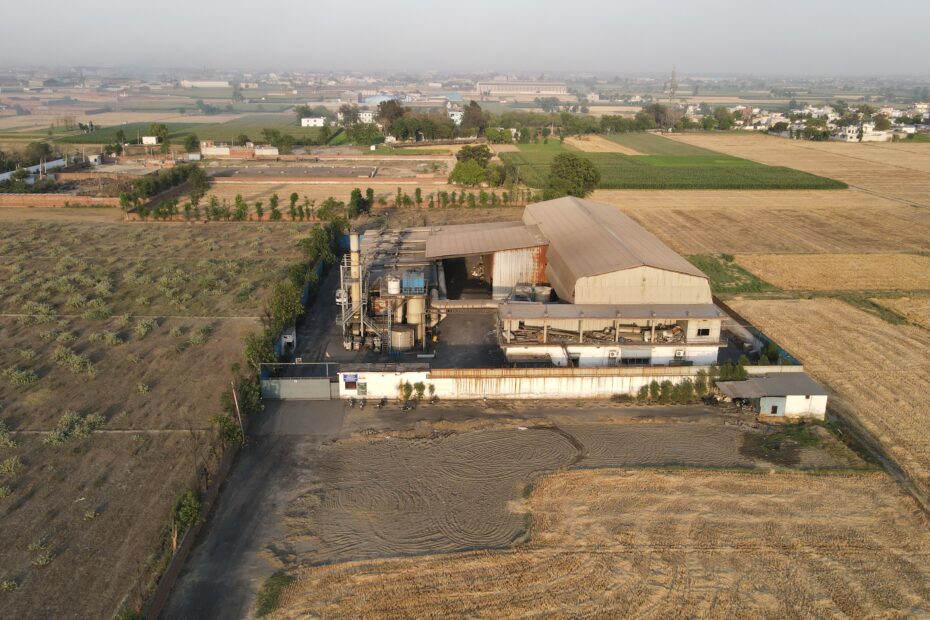
The plant in Mandi Gobindgarh, Punjab, has been melting steel since 2000 and now runs three 15-MT furnaces. The single most important machine in the quality story sits right at the front door: a BIRIM MAKINA scrap sorting and crushing system. That’s where tramp elements get caught before they’re ever in the bath, while they’re still a problem you can fix by sorting rather than one you’re stuck with after melting. Get this stage right and the rest of the line has a fighting chance. Skip it and no amount of downstream care recovers the chemistry.
From there the steel moves through the whole chain in-house, and each step is its own quality gate:
- Scrap to billet. Sorted scrap is melted and continuously cast into steel billets square sections from 75mm to 150mm. Continuous casting (commissioned here in 2013, replacing the older ingot route) is what keeps the internal structure uniform and segregation low. Every heat is chemically analyzed before it’s cleared. If you want the deeper background on this stage, there’s a full breakdown in what is a steel billet, and the older ingot-vs-billet route explains why the casting change mattered.
- Billet to HR coil. Those billets are hot-rolled into HR coil, 1.6mm to 4mm thick. R.P. Multimetals was among the first in the region to hot-roll the strip before coiling a process decision that still shows up as better dimensional accuracy and stronger mechanical properties in the finished coil. The mechanics of that are covered in how hot rolled steel coil is made.
- HR coil to pipe. The same coil feeds the pipe plant, where it becomes ERW pipe in the 31–88 OD range, certified across IS 18573, IS 1161, IS 4923, and IS 3601.
The point of describing all four stages isn’t completeness for its own sake. It’s that traceability only exists when one operation owns the whole chain. When the same company sorts the scrap, casts the billet, rolls the coil, and welds the pipe, a Mill Test Certificate at the end isn’t a piece of paper from three suppliers ago — it’s a record of metal the mill controlled from the melt forward. That’s the difference a procurement manager is actually buying when they choose an integrated secondary producer over a re-roller, and it’s why the “scrap-based” label, on a line like this, stops being a red flag.
When each one makes sense
Stripping it down to a decision a buyer can use:
Go scrap-based when the grade is standard structural or general-engineering steel; the application is rebar, beams, fabrication coil, water or gas pipe, or machinery sections; cost and lead-time stability matter; and you have a sustainability or embodied-carbon target to hit. This is the default for most procurement, and it’s the right default.
Go primary when you’re cold-heading or deep-drawing; the part is safety-critical automotive, aerospace, or defence; the spec demands ultra-low impurities (electrical steel, bearings, exposed panels); or a building code or contract on your project names primary steel specifically. Some Indian standards and some project specs still stipulate it when they do, the metallurgy debate is over and you follow the spec.
And in practice, you’ll often use both. A single structure leans on primary for the high-load, safety-critical members and scrap-based for everything supporting them. The skill in procurement isn’t picking a side. It’s matching the route to each component and not overpaying for primary on the 80% of the bill of materials that secondary handles just as well.
Is scrap-based steel worse than primary steel?
Not for most applications. For standard structural and general-fabrication grades, scrap-based steel made under proper chemistry control performs identically to primary steel and meets the same IS standards at lower cost and lower carbon. Primary steel is genuinely better only in specific cases: cold-forming, ultra-low-impurity applications, and safety-critical parts where tramp elements or nitrogen content matter. The real quality variable isn’t primary versus secondary. It’s whether the producer controls scrap sorting, melt chemistry, and the downstream process which is exactly what an integrated, certified line is built to do.
The bottom line for procurement
Stop treating “scrap-based” as a quality grade. It’s a production route, and on a controlled line it produces steel that clears the same standards as primary for nearly everything you’ll build. Read the Mill Test Certificate, check the IS compliance, and ask the supplier one question that cuts through all of it: how much of this chain do you control? A mill that sorts its own scrap and runs the metal through to finished product is giving you traceability a re-roller structurally can’t. For the projects where primary is genuinely required, spec it without apology. For everything else which is most things scrap-based steel from an integrated producer is the better buy, and it isn’t close.
If you’re weighing suppliers for billets, HR coils, or pipes, the steel division at R.P. Multimetals runs the full scrap-to-finish chain under one roof, or you can talk through specs with the team directly.