
Key Takeaways
- IS 1239 is the right call for fluid transport, plumbing, gas lines, and scaffolding it’s built around pressure ratings and pipe classes (Light, Medium, Heavy), not structural grades.
- IS 1161 is the correct standard for load-bearing structural applications columns, trusses, hollow sections in RCC frames because it specifies yield strength grades up to YST 310 and YST 355.
- Both are BIS-governed ERW pipe standards, but they test pipes for completely different failure modes. IS 1239 prioritises the hydraulic pressure test. IS 1161 prioritises tensile and yield strength tests with Charpy impact testing at higher grades.
- Specifying the wrong standard doesn’t just create a compliance headache; it either leaves structural capacity on the table (if you use IS 1239 for columns) or you overpay for mechanical properties you’ll never use (if you use IS 1161 YST 310 for a plumbing loop).
- For most Indian infrastructure projects, you’ll need both standards on the same bill of materials one for the structural skeleton, one for the MEP services running through it.
The procurement spec lands on your desk. It says “ERW MS pipe” and lists a size. No standard mentioned. Do you default to IS 1239 or IS 1161?
If you don’t know the answer immediately, you’re in good company and also in a position where the wrong call can cost real money. Not because one standard is better than the other. Because they were designed to solve different problems, and the Indian steel industry produces pipes under both without any visible difference on the outside.
Here’s how to get it right every time.
Quick Verdict
Specify IS 1239 if your pipe is carrying a fluid (water, gas, compressed air), serving as scaffolding, or being used in general mechanical applications where the controlling parameter is pressure rating, not structural load capacity.
Specify IS 1161 if your pipe will carry structural load columns, hollow sections in RCC frames, roof trusses, piling, sign gantries, or any application where yield strength and elongation under stress are the design criteria.
Neither standard is universally “stronger” or “better.” A Heavy class IS 1239 pipe has a thicker wall than a Light wall IS 1161 pipe at the same nominal size. The difference is what the standard demands you test and certify — and what your design engineer is relying on when they sign off the drawing.
At-a-Glance Comparison
| Parameter | IS 1239 | IS 1161 |
| Primary application | Fluid transport, plumbing, gas, scaffolding | Structural columns, trusses, hollow sections |
| Size range (Part 1) | NB 6mm to NB 150mm (¼” to 6″) | OD 21.3mm to 609.6mm |
| Wall classification | Light / Medium / Heavy classes | Specified wall thickness in mm |
| Grades available | Typically YST 210 | YST 210 / YST 240 / YST 310 / YST 355 |
| Governing test | Hydraulic pressure test | Tensile, yield strength, elongation |
| Impact testing | Not required | Required for YST 310 and above |
| End finish | Threaded (most common) or plain | Plain or beveled (for welding) |
| BIS revision | IS 1239:2004 | IS 1161:2014 |
| Manufacturing routes | ERW, seamless | ERW, HFW, HFS, HRIW |
How to Read This Comparison
These two standards aren’t competing they occupy different rungs of the same supply chain. To compare them fairly, you need to evaluate them the way a structural consultant or a project procurement head actually would: what failure mode is the pipe being protected against, and does the standard’s mandatory testing catch that failure mode before the pipe reaches site?
That’s the lens we’re using here.
Head-to-Head: The Criteria That Actually Matter
1. Mechanical Strength — IS 1161 wins decisively for structural work
IS 1239 pipes are certified at YST 210, which means a minimum yield strength of 210 MPa and minimum tensile strength of 330 MPa. That’s adequate for carrying internal pressure. It’s not the number a structural engineer uses when calculating the load capacity of a tubular column.
IS 1161 gives you three grades above YST 210. YST 310 minimum yield 310 MPa, tensile 450 MPa is what most structural drawings in Indian construction actually call for when the pipe is a load-bearing element. YST 355, available under the 2014 revision, is used in high-rise and infrastructure applications where the column section needs to stay tight without going to heavy wall thicknesses.
The practical effect: a IS 1161 YST 310 pipe and a IS 1239 Medium class pipe at the same OD and wall thickness look identical. The steel chemistry and mill processing that gets one to 310 MPa yield and keeps the other at 210 MPa that’s the difference the standard enforces.
2. Testing Protocol — Different standards, different failure modes
IS 1239 mandates a hydraulic pressure test on every pipe. The pipe is pressurised to a defined test pressure and must hold without leaking or showing distress. That test is exactly right for a water main or a gas distribution line.
IS 1161 mandates tensile testing, yield strength measurement, and elongation percentage mechanical properties that tell you how the tube behaves under axial and bending load. At YST 310 and above, Charpy impact testing is also required, which confirms the material won’t undergo brittle fracture in low-temperature or dynamic load conditions.
Neither standard runs the other’s primary test as a routine requirement. If you specify IS 1239 for a structural column and a quality audit asks for tensile test certificates, you won’t have them because the standard didn’t require them.
3. Size Coverage — IS 1161 covers far more ground
IS 1239 Part 1 stops at NB 150mm (6 inch nominal bore). For larger diameter structural hollow sections the kind used in long-span roof trusses, pipe racks in petrochemical plants, or transmission tower legs IS 1239 simply doesn’t cover the sizes. IS 1161 goes up to 609.6mm OD.
For the common pipe sizes used in Indian construction (NB 25mm to NB 100mm), both standards have overlapping coverage. That overlap is exactly where the confusion happens.
4. End Finish and Jointing — Different fabrication intent
IS 1239 pipes are most commonly supplied with threaded ends and socket joints (Part 2 of the standard covers fittings). The entire system is designed around screwed assemblies which makes it fast to install for plumbing and gas lines, but wrong for structural welded connections.
IS 1161 pipes are supplied plain-ended or bevel-cut, ready for butt welding or fillet welding into structural connections. Specifying IS 1161 when you need screwed plumbing will mean re-threading on site or sourcing non-standard fittings.
5. Cost — IS 1239 is typically lower cost at equivalent sizes
The mill processing to achieve YST 310 grade controlled chemistry, precise heat treatment or thermomechanical rolling costs more than standard YST 210 production. IS 1239 Medium class pipe at a given OD and wall will generally land cheaper per metre than IS 1161 YST 310 at the same dimensions.
For plumbing work, you’d be paying for mechanical properties you can’t use and tests your installation doesn’t require. The cost gap varies by market conditions and mill, but on a large project it adds up.
Which Standard for Which Application
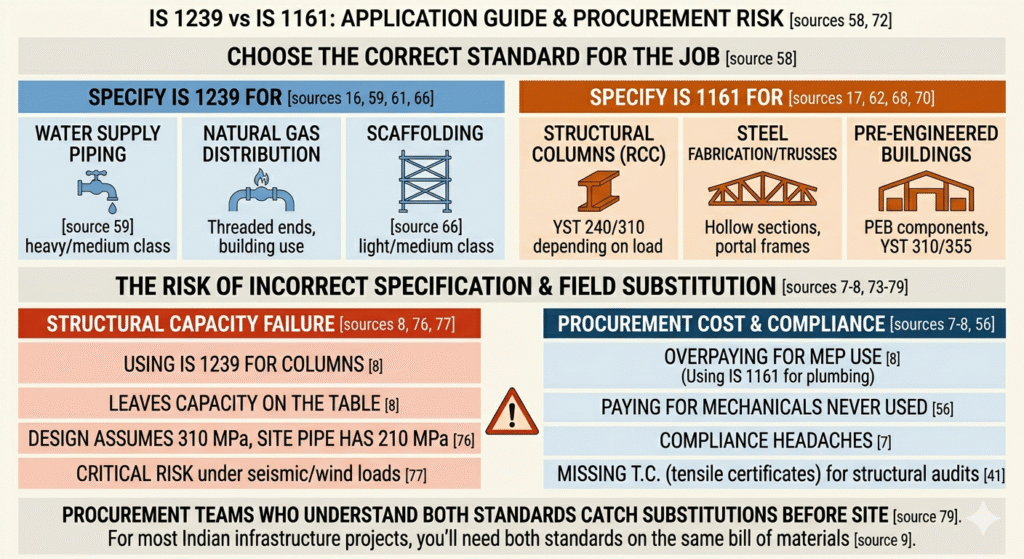
Water supply piping (overhead tanks, underground mains): IS 1239 Medium or Heavy class. The hydraulic pressure test is what protects you here, not the yield grade.
Natural gas distribution within a building: IS 1239, per most Indian gas utility specifications. Threaded ends, pressure-tested, traceable certification.
Structural columns in an RCC building: IS 1161 YST 240 or YST 310 depending on the design load. Your structural consultant’s drawing will specify don’t substitute IS 1239 here.
Industrial pipe rack structures: IS 1161 YST 310. These structures carry their own weight plus the dead load of process piping. YST 210 leaves insufficient safety margin.
Scaffolding on a construction site: IS 1239 Light or Medium class. Scaffolding tube in India has historically been IS 1239 territory; the wall thickness classes map well to standard coupling systems.
Hollow sections in a steel fabrication job (trusses, purlins, portal frames): IS 1161. Full stop. A fabricator making a Pratt truss from IS 1239 pipe is working outside the specification the structural drawing was based on.
Pre-engineered building (PEB) components: IS 1161 YST 310 or YST 355, depending on the section forces. PEB manufacturers are very clear on this the connection design assumes the grade.
A Note on Substitution in the Field
This is where projects go wrong. A contractor gets an IS 1161 YST 310 item on the BOM. The local stockist has IS 1239 in the same OD and wall. The dimensions are identical. The substitution happens — sometimes with full knowledge, sometimes through a genuine misunderstanding of what the standards mean.
The structural engineer’s calculation used 310 MPa as the design yield strength. The actual pipe on site has 210 MPa. At normal operating loads the difference may never show. Under seismic load, wind event, or any scenario where the design assumed yield before fracture, the gap matters.
This is a systems problem as much as a materials problem. Procurement teams who understand both standards catch substitutions before they reach site. That’s the real value of knowing the difference.
Frequently Asked Questions
Can an ERW pipe be certified under both IS 1239 and IS 1161 simultaneously?
Yes. A manufacturer who runs the tests required by both standards hydraulic test (IS 1239) and mechanical property tests (IS 1161) can certify a pipe dual-standard, provided the steel grade and dimensions meet both sets of requirements. This is common for pipes in the overlapping size range (NB 25mm to NB 150mm) supplied to large projects that specify both standards in the same BOM. Ask the supplier for dual test certificates if your project requires it.
IS 1239 has Light, Medium, and Heavy classes. IS 1161 has YST grades. How do these map to each other?
They don’t map directly because they’re measuring different things. IS 1239’s classes (Light/Medium/Heavy) refer to wall thickness at a given nominal bore. IS 1161’s YST grades (210, 240, 310, 355) refer to minimum yield strength regardless of wall thickness. A Heavy class IS 1239 pipe has more wall than a Light class pipe. A YST 310 IS 1161 pipe has higher yield strength than a YST 210 pipe at the same wall thickness. You need to specify both the wall and the grade clearly for structural work.
My supplier says IS 1239 “Heavy class” is strong enough for structural use. Is that correct?
Not necessarily. “Heavy” in IS 1239 means a thicker wall, which does increase the section capacity. But the steel mill is only required to certify yield strength at YST 210 under IS 1239. Your structural engineer’s design may require YST 240 or YST 310. Without mandatory mechanical testing to those grades, you have no certified basis for the higher yield assumption even if the steel could theoretically achieve it. Get IS 1161 certification for structural applications.
What’s the difference between IS 1239 Part 1 and Part 2?
IS 1239 Part 1 covers the pipes themselves (plain end tubes, dimensional and pressure requirements). Part 2 covers the fittings the malleable cast iron and steel screwed fittings (elbows, tees, unions, sockets) used with Part 1 pipes. When your MEP spec says “IS 1239 system,” it typically means Part 1 pipes with Part 2 fittings throughout.
IS 1161 mentions HFW and HFS manufacturing routes. Does that matter if I’m buying ERW specifically?
Yes — declare the manufacturing route on your purchase order. ERW and HFW (high frequency welded) produce similar pipes through slightly different welding processes; both are electric/electromagnetic weld methods and are often grouped together. HFS (hot finished seamless) is a different product with no weld seam and typically different mechanical behaviour. If your design assumes ERW, specify ERW on the order. IS 1161’s scope includes all three, but they’re not interchangeable without reviewing whether the design assumption holds.
For a contractor buying off the shelf, which standard is more readily available in Indian markets?
IS 1239 Medium and Heavy class are the most widely stocked ERW pipe products in Indian stockyards — particularly in the common NB sizes (NB 15mm to NB 100mm). IS 1161 YST 240 and YST 310 are well stocked in the larger trading hubs (Mumbai, Delhi, Hyderabad) but may require lead time at smaller markets or for non-standard sizes. Plan procurement schedules accordingly on projects that specify IS 1161 YST 310 in larger OD ranges.
R.P. Multimetals manufactures ERW pipes certified under both IS 1239:2004 and IS 1161:2014 from in-house HR coils — giving you traceable, mill-certified supply for both standards from a single source. Get in touch with our team to discuss your project’s pipe specifications.