
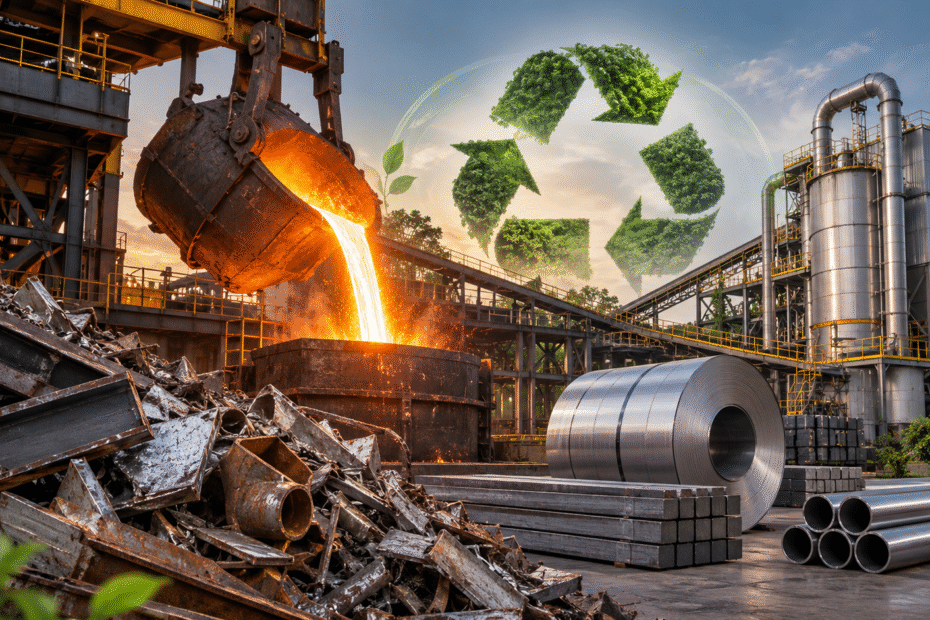
A rusted beam from a demolished warehouse. Offcuts from a fabrication shop. A truck of old pipes. That’s what arrives at our yard, and a few stages later it leaves as billets, HR coil and ERW pipe for builders, fabricators and pipe makers across India.
R.P. Multimetals has been melting steel since 2000, and scrap is our main raw material. That makes us a secondary steel manufacturer, part of the sector that makes roughly 40% of India’s steel and recycles metal instead of mining it. Since 2023 our Zinc Division has gone one step further. It takes the zinc-laden dust our furnaces give off, a by-product most plants pay to dispose of, and refines it into zinc ingots and sheets of 99% purity and above.
This post covers what green steel in India actually means, where scrap-based steel fits, and how a single tonne of scrap moves through our plant. We’ll also be straight about what we can and can’t claim yet. (In a sector full of green labels, we think that’s the more convincing story anyway.)
What is green steel in India?
Green steel in India is steel from a plant whose verified emission intensity is below 2.2 tonnes of CO2e per tonne of finished steel. The Ministry of Steel’s taxonomy, issued in December 2024, grades it from three to five stars, and the National Institute of Secondary Steel Technology (NISST) measures and certifies it.
The star bands, as published on the Ministry of Steel’s Green Steel Initiative page:
| Rating | Emission intensity (t CO2e per tonne of finished steel) |
| Five-star | Below 1.6 |
| Four-star | 1.6 to 2.0 |
| Three-star | 2.0 to 2.2 |
| Not eligible | Above 2.2 |
The system is already running. The Ministry reports that 90 steel units were certified in FY 2025–26, covering 12.4 million tonnes of green steel.
Notice what the definition measures. It’s the plant’s emissions, not the raw material. Scrap gives a plant a big head start, but the label itself comes from a verified number. We’ll come back to why that matters for us.
Scrap is a secondary raw material, and a valuable one
India’s Steel Scrap Recycling Policy (2019) puts it plainly: iron ore is the primary raw material for steel, and used steel in the form of scrap is the secondary one. That’s where the term “secondary steel” comes from. It has nothing to do with second-grade quality.
So what does melting scrap instead of mining ore actually save? worldsteel’s widely used figures say every tonne of scrap used in steelmaking avoids:
- 1.5 tonnes of CO2
- 1.4 tonnes of iron ore
- 740 kg of coal
- 120 kg of limestone
Picture a single 20-tonne truckload of scrap at our gate. Melted instead of mined, it spares roughly 28 tonnes of iron ore and 15 tonnes of coal, and keeps about 30 tonnes of CO2 out of the air. Now multiply that by every truck, every working day.
One honest caveat. Much of India’s secondary sector still feeds its furnaces with coal-based sponge iron, which is the most emission-heavy route in the country. The benefit above comes from scrap specifically, and scrap is the main charge in our melt shop. If you’re weighing scrap-based steel against ore-based steel for a project, our guide to scrap-based steel vs primary steel compares quality, cost and fit.
How one tonne of scrap moves through our plant
We didn’t build this loop in one go. It grew a stage at a time over 25 years:
- Melting (since 2000). Scrap is melted in our induction furnaces. Ingot output grew from 75 MT a day to 200 MT a day between 2002 and 2012.
- Billets (since 2013). A continuous casting machine replaced ingots with precision-cast billets, 75 mm to 150 mm square.
- HR coil (since 2014). Our rolling mill turns those billets into hot rolled coil, 1.6 mm to 4 mm thick.
- ERW pipes (since 2015). The pipe plant forms that coil into ERW pipes for water, gas and structural work.
- Zinc (since 2023). The dust captured from the furnaces goes to our Zinc Division instead of a landfill.
Because every stage feeds the next on one site, a tonne of scrap can leave our gates as finished pipe without passing through anyone else’s hands. That’s good for traceability. It’s also why quality stays consistent: our products meet IS 2830, IS 1239, IS 1161, IS 4923, IS 3601 and IH 10748. (For the casting side in detail, see our walkthrough of the steel billet manufacturing process.)
Steel leaves as billets, coil and pipe; the furnace dust becomes zinc that galvanizes new steel, and both come back to the yard as scrap.
The dust problem, and how our Zinc Division solves it
Here’s something most people outside a melt shop never think about. A lot of scrap is galvanized steel: pipes, car panels, all coated in zinc to stop rust. When that scrap melts, the zinc boils off and is caught by the furnace’s pollution control system as a fine dust.
That dust is a headache. Environmental rules in most countries treat it as hazardous waste because of the heavy metals it carries, so it can’t simply be dumped. Yet when the charge includes galvanized scrap, the dust can hold 15% to 40% zinc by weight. Landfilling it means burying a metal that someone else will then have to mine.
We set up our Zinc Division in 2023 to stop doing that. Today it can produce up to 5 MT of zinc a day from furnace waste:
- Zinc ingots at 99% purity and above, used in galvanizing, alloys, chemicals, rubber and batteries
- Zinc sheets at 99.5% purity, used in roofing, ingots, galvanizing, fabrication and automotive work
And this is the part we like most. The biggest use of zinc is galvanizing steel. That galvanized steel serves for decades, then comes back to a yard like ours as scrap, and its zinc ends up in our dust again. Steel and zinc go round the same circle. That’s what a circular economy looks like on a factory floor. (New to zinc grades? Start with What Are Zinc Ingots?)
Our recycling counter
Numbers say more than adjectives, so here are ours.
| What we recycled | Amount (tonnes) |
| Scrap melted into new steel, FY 2025 – 26 | 156,975 |
| Furnace dust processed by the Zinc Division since 2023 | 11,500 |
| Zinc recovered from that dust since 2023 | 4,600 |
| Estimated CO2 avoided by using scrap instead of ore, FY 2025–26 | ≈ 235,000 |
How we estimate the last line: we multiply the scrap we melted by worldsteel’s global average of 1.5 tonnes of CO2 avoided per tonne of scrap. It’s a comparison with making the same steel from iron ore, not a measured footprint of our plant. We’ll update these figures every year.
Is scrap-based steel automatically green steel?
No, and any mill that tells you otherwise is skipping a step.
Scrap-based steel starts far ahead of ore-based steel. But under India’s taxonomy, the green label depends on the plant’s whole emission intensity, and electricity is a big part of that. Induction and electric arc furnaces draw power from a grid that still runs largely on coal. JMK Research puts standalone electric and induction furnace operations at 1.6 to 2.6 tonnes of CO2 per tonne of crude steel, a range that straddles the 2.2 threshold. Where a plant lands depends on its power source, its charge mix and how efficiently it runs.
So here’s where we stand. We haven’t put our plant through NISST’s green steel certification yet, and until we have a verified number, we won’t print a star rating on our steel. What we can say with evidence is this: we make steel on the route that India’s policymakers count on for decarbonisation, scrap is our main raw material, and we recover zinc from a waste stream most plants landfill.
The levers from here are well understood. IEEFA’s October 2026 analysis found that combining 30% scrap with 50% renewable electricity could cut a secondary producer’s emission intensity by around 28%. For a scrap-led plant like ours, cleaner power is the next big step.
What this means for buyers, and for a greener India
If you buy billets, coil or pipe, you’re increasingly asked where your steel comes from. Listed customers want data for their sustainability reports. Exporters to Europe now face carbon reporting on steel content. A supplier who can tell you the raw material, the route and the recycled share makes those conversations easier, and we’re happy to share ours with any buyer who asks.
You don’t give anything up on quality, either. Our scrap-based steel is made to the same Indian Standards as any other, and every coil and billet is tested before dispatch.
The bigger picture is simple. India has set its steel sector a target of net zero emission intensity by 2070, and the Ministry’s own roadmap counts on renewable power, material efficiency and cleaner process routes to get there, while its scrap policy names scrap-based steelmaking as a way to cut emissions. Secondary steelmakers already sit on that path. Our job is to prove it, one verified tonne at a time.
Frequently asked questions
What is secondary steel? Secondary steel is steel made mainly from recycled scrap, usually in induction or electric arc furnaces, rather than from iron ore in a blast furnace. India’s scrap policy calls scrap the industry’s secondary raw material, which is where the name comes from.
Is scrap-based steel as strong as steel made from iron ore? Yes, when it’s made and tested to the right standard. Our billets, HR coils, ERW pipes and rounds meet IS 2830, IS 1239, IS 1161, IS 4923, IS 3601 and IH 10748. Steel can be recycled repeatedly without losing its properties.
Is scrap-based steel green steel? Not automatically. India’s green steel label goes to plants with a verified emission intensity below 2.2 t CO2e per tonne of finished steel. Scrap gives a large head start, but power source and plant efficiency decide the final number.
Can zinc be recovered from steel furnace dust? Yes. Melting galvanized scrap leaves zinc-rich dust that is otherwise treated as hazardous waste. Our Zinc Division recovers it into ingots of 99%+ purity and sheets of 99.5% purity, with capacity of up to 5 MT a day.
How much CO2 does recycled steel save? Worldsteel estimates that every tonne of scrap used avoids about 1.5 tonnes of CO2, along with 1.4 tonnes of iron ore, 740 kg of coal and 120 kg of limestone.
Work with a scrap-led steel and zinc manufacturer
Looking for billets, HR coil, ERW pipes or zinc made from recycled material? Request a quote and ask us for the raw material and recycled-content details for your order. Investors can follow our progress on the Investor Relations page.